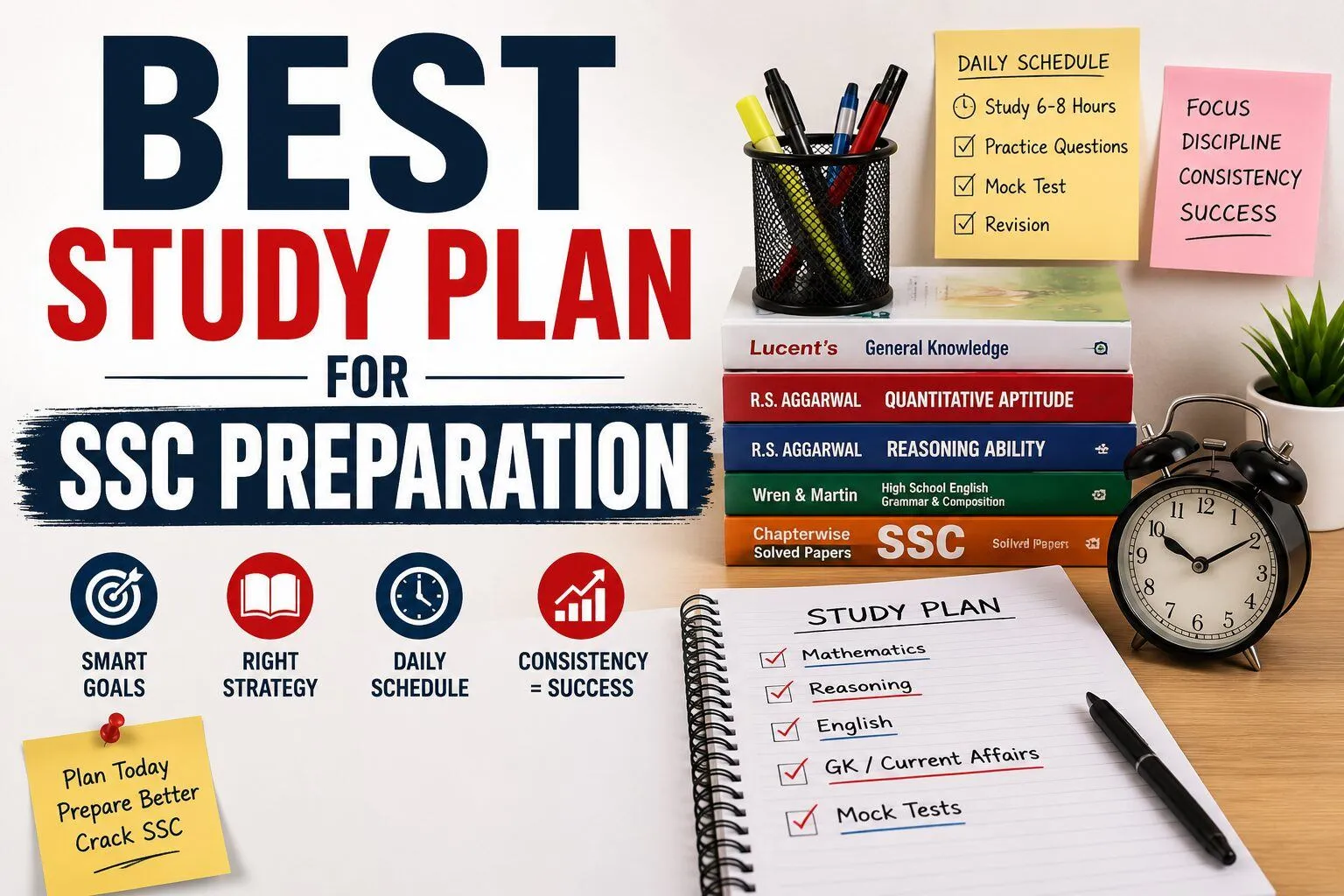
Best Study Plan for SSC Preparation (The One I Actually Followed)
Everyone asks for the best study plan for SSC preparation, and honestly, for the first year of my own prep, I didn’t have one. I had a rough idea, a bunch of screenshots saved from Telegram, and a timetable I rewrote at least six times because I kept “optimizing” it instead of following it.
That’s the trap nobody warns you about. You spend so much time designing the perfect plan that you forget the plan only works if you actually stick to a version of it for more than four days.
So this isn’t going to be a picture-perfect 18-hour timetable that looks great on Instagram and lasts exactly one Monday. This is the study plan I settled into after wasting a good three or four months figuring out what doesn’t work. It’s not glamorous, but it’s honest, and it’s the version that actually got me through mocks, revision, and eventually decent scores.
Why Most SSC Study Plans Fail Before They Even Start
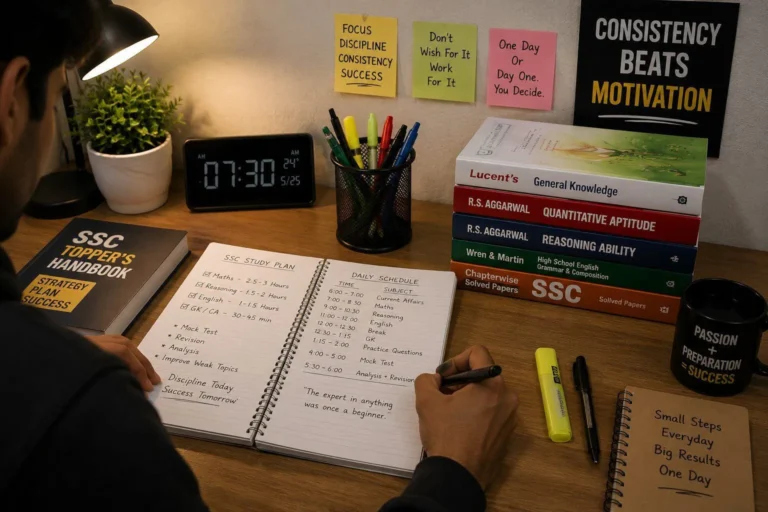
Here’s the pattern I see over and over, and honestly repeated myself for a while: someone downloads a “perfect” study plan from a topper’s interview, tries to copy it exactly, and quits within a week because it wasn’t built for their life.
A topper’s plan usually assumes:
- No job, no college, no family responsibilities
- Already strong basics in at least two subjects
- A level of discipline they built over months, not day one
If you copy that plan on day one of your own preparation, you’re not following a study plan — you’re following someone else’s endpoint. The best study plan for SSC preparation isn’t a fixed template you download. It’s a structure you adapt to where you actually are right now.
That distinction alone would have saved me months.
Step One: Be Honest About Your Actual Available Time
Before building any study plan, sit down and actually track your day for three or four days. Not what you think you do — what you actually do.
Most people are shocked by how much time disappears into scrolling, “just five more minutes” breaks, and travel. I certainly was.
Once you know your real available hours, you can build a best study plan for SSC Preparation around reality instead of ambition. A working aspirant with 3 honest hours a day will outperform a student who plans for 10 hours but actually studies for 4, simply because the working aspirant’s plan matches their life.
Realistic Daily Hours by Situation
| Your Situation | Realistic Daily Study Hours |
|---|---|
| Full-time student, no job | 6–8 hours |
| College student with classes | 4–6 hours |
| Working professional | 3–4 hours |
| Preparing alongside another exam | 2–3 hours |
Pick the row that’s actually true for you, not the one that sounds impressive.
The Structure Behind the Best Study Plan for SSC Preparation
Once you’re honest about your time, the actual structure of a best study plan for SSC Preparation comes down to four moving parts:
- Concept building — learning new topics
- Practice — solving questions on what you’ve learned
- Revision — going back over what you’ve already studied
- Mock tests and analysis — testing yourself and fixing weak spots
Most bad study plans only include the first two. That’s exactly why people finish their syllabus and still feel unprepared — there’s no revision loop and no feedback loop built in.
Any study plan you build, whether it’s mine or one you design yourself, needs all four parts working together, not just concept-building on repeat.
Monthly Breakdown: A 5-Month Best Study Plan for SSC Preparation
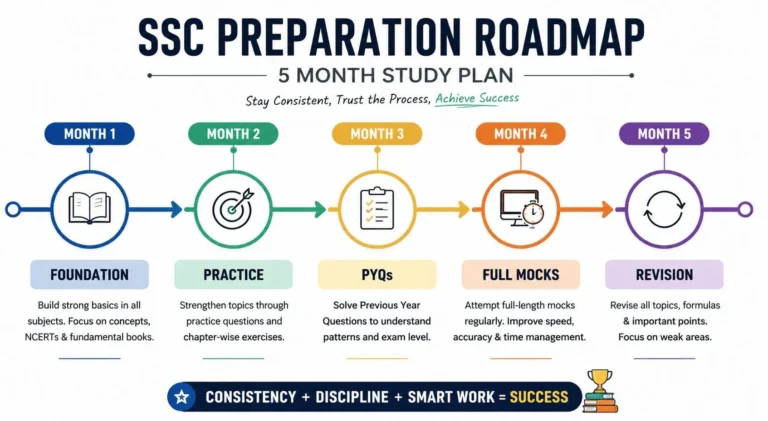
I’m going to lay this out as a 5-month plan since that’s roughly what worked for me to achieve this Best study plan for SSC Preparation, but stretch or compress it based on your own timeline and how much ground you’re starting from.
Month 1: Foundation
This month is entirely about basics. Don’t touch PYQs seriously yet — you’ll just get discouraged.
- Maths: Number system, percentage, ratio, basic algebra
- Reasoning: Analogy, classification, series
- English: Tenses, basic grammar rules, daily vocabulary (10 words a day is enough)
- GK: First read-through of Lucent, no memorization pressure yet
Month 2: Practice Begins
Now you start applying what you learned. This is where a lot of people quietly give up because progress feels slow.
- Maths: Topic-wise practice sets, timed per topic
- Reasoning: Continue building speed with daily sets
- English: Start error-detection practice, keep vocabulary going
- GK: Begin current affairs alongside static GK
Month 3: PYQs and Sectional Mocks
By now your basics should be reasonably solid, so previous year questions start making sense instead of feeling random.
- Solve at least 3–5 years of PYQs, subject-wise
- Start sectional mocks (one subject at a time)
- Keep an error notebook running from this point onward
Month 4: Full-Length Mocks
This is where the real exam simulation starts.
- One full-length mock every week, minimum
- Analyze every mock the same day, not “later”
- Identify your two or three weakest topics and target them specifically
Month 5: Revision and Speed
The final stretch is almost entirely revision, not new content.
- Revise formulas, grammar rules, and GK notes weekly
- Increase mock frequency to twice a week if possible
- Focus on time management within each section, not just accuracy
This is roughly the skeleton of the best study plan for SSC preparation that I’d recommend to anyone starting fresh, though your exact pace will depend on how much time you have before your target exam.
Subject-Wise Time Allocation
People always ask how to split their day across subjects, and there’s no perfect universal answer, but here’s a distribution that worked reasonably well for me and for a few friends I compared notes with.
| Subject | Daily Time (6-Hour Plan) | Why |
|---|---|---|
| Mathematics | 2–2.5 hours | Highest weightage, biggest score swing |
| Reasoning | 1.5 hours | Improves fast with steady daily practice |
| English | 1–1.5 hours | Scoring section, needs daily consistency more than long sessions |
| GK / Current Affairs | 45 minutes–1 hour | Best done in short, frequent sessions rather than long ones |
If you only have 3–4 hours a day, don’t try to cram all four subjects in every single day. It’s genuinely fine to focus on two subjects deeply on some days and the other two on alternate days, as long as nothing gets ignored for more than 48 hours.
A Sample Weekly Structure
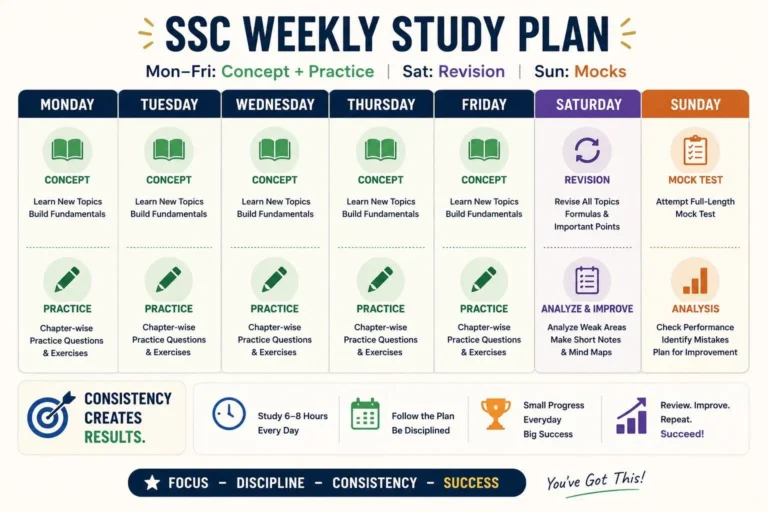
Daily routines are useful, but a study plan really shows its value across a full week, because weekdays and weekends shouldn’t look identical.
Monday to Friday: Focus on concept-building and topic-wise practice. Keep sessions shorter but consistent — this is when most people have work, college, or other commitments pulling at their time.
Saturday: Dedicate this to revision. Go back over the week’s topics, redo the questions you got wrong, and update your error notebook. Don’t add brand-new topics on Saturdays if you can help it.
Sunday: This should be your mock test and analysis day. Take one full-length or sectional mock in the morning, then spend the afternoon actually going through every wrong answer, not just checking your score and moving on.
A best study plan for SSC Preparation that treats Saturday and Sunday exactly like weekdays usually burns people out by month two. Building in a lighter, revision-focused rhythm is part of what makes a study plan sustainable rather than just impressive on paper.
Where Most Study Plans Go Wrong
I made almost every mistake on this list at some point, so take this as lived experience rather than a lecture.
Mistake 1: Planning down to the minute A study plan with 15-minute blocks for everything looks organized but falls apart the first time life interrupts you. Build in buffer time.
Mistake 2: No revision built in If your study plan is 90% new content and 10% revision, you’ll forget most of what you learned by month three. Flip that ratio as you progress.
Mistake 3: Ignoring mocks until “later” Mocks aren’t a final-month activity. They should start early, even if your scores are embarrassing at first.
Mistake 4: Copying someone else’s exact schedule As mentioned earlier, a study plan built for someone else’s life rarely survives contact with yours.
Mistake 5: Restarting the plan after every missed day Missing one day doesn’t mean the whole plan failed. Pick it back up the next day instead of scrapping it and starting a “new, better” version — this is the loop that keeps people stuck at the planning stage for months.
How to Build Your Own Personalized Study Plan
If none of the templates above fit your life exactly — and honestly, most won’t fit perfectly — here’s how to build your own version.
- Start with your honest available hours, not your ideal ones
- List your weak subjects and give them slightly more time than your strong ones
- Build in one full revision day per week, non-negotiable
- Start mocks by month two or three at the latest, not “when you feel ready”
- Review your plan every 3–4 weeks and adjust based on what’s actually working
A study plan isn’t something you set once and follow blindly for six months. The best study plan for SSC preparation is really a living document — you adjust it as your strengths and weaknesses shift, without throwing out the whole structure every time something feels slightly off.
Best Study Plan for SSC Preparation for Working Professionals
If you’re preparing alongside a job, your version of this study plan will look different, and that’s fine.
- Use early mornings (5:30–7:30 AM) for Maths or Reasoning, when your mind is freshest
- Use commute time for vocabulary or current affairs, if you’re not driving
- Reserve evenings for one focused 90-minute block rather than trying to study in scattered 20-minute bursts
- Use weekends for mocks and revision, since weekdays realistically won’t allow for full-length tests
Working professionals often out-prepare full-time students simply because their limited hours force better discipline. Don’t underestimate what 3 focused hours a day can do over five or six months.
Best Study Plan for SSC Preparation for Students Preparing Alongside College or School
If you’re still studying, the challenge isn’t time — it’s fragmentation. Classes, assignments, and exams constantly interrupt your SSC preparation.
- Protect at least one uninterrupted 2-hour block daily, ideally the same time each day
- Use free periods or study halls for practice sets rather than saving everything for evening
- Don’t sacrifice sleep to “fit everything in” — tired studying is far less effective than rested studying
- Treat semester exam weeks as revision-only weeks for SSC, rather than trying to push new content
Revision: The Part Every Study Plan Underestimates
If there’s one thing I’d change about my own early study plan, it’s how little revision time I built in. I treated revision as something to “get to eventually,” and eventually became never.
A rough revision rhythm that works:
- Daily: 15–20 minutes reviewing what you studied the previous day
- Weekly: One dedicated revision day covering the entire week
- Monthly: A full weekend revisiting formulas, grammar rules, and static GK from scratch
Revision isn’t glamorous, and it doesn’t feel like “real progress” the way learning something new does. But it’s the actual difference between a study plan that produces results and one that just produces the feeling of being busy.
Tools to Track and Stick to Your Study Plan
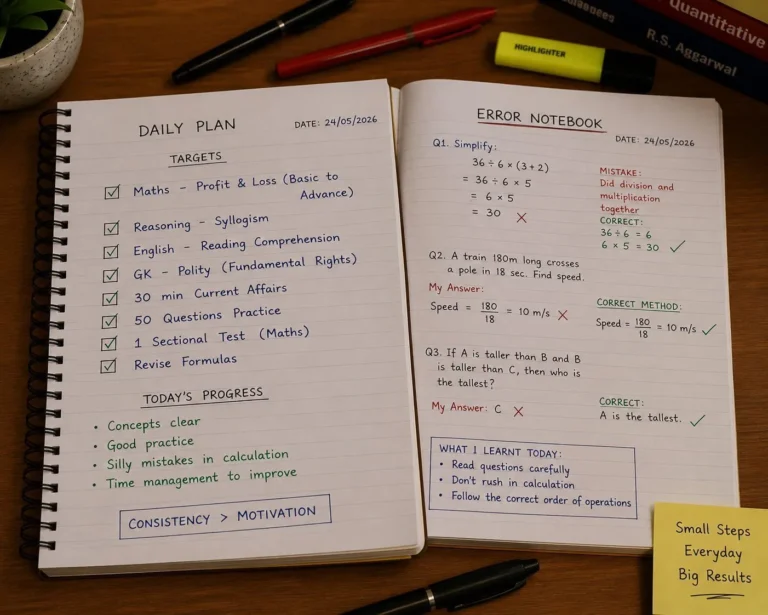
A study plan that only exists in your head rarely survives more than a couple of weeks. You don’t need anything fancy to track it — I used a simple notebook for most of my prep and it worked fine.
- A basic weekly planner or notebook to write down what you actually studied, not just what you planned to
- A simple checklist for daily targets, ticked off each evening
- A separate page for your error notebook, reviewed every Saturday as part of the weekly revision slot mentioned earlier
- A monthly page where you rewrite your subject-wise time allocation if it needs adjusting
The tool matters far less than the habit of actually checking in with your own best study plan for SSC Preparation daily. I tried three or four planning apps at different points, and honestly a plain notebook outperformed all of them, simply because writing by hand made me more honest about what I’d actually done that day.
Signs Your Best Study Plan for SSC Preparation Needs Adjusting
Every study plan needs tweaking at some point — treating your first draft as final is one of the quieter ways preparation stalls out.
Watch for these signs:
- You’re consistently unable to finish your daily targets, week after week
- One subject is improving fast while another hasn’t moved in a month
- Mock scores have plateaued despite sticking to the plan closely
- You feel burnt out rather than just tired
If you notice two or more of these, it’s time to revisit your study plan rather than push through blindly. Sometimes the fix is as small as swapping 30 minutes from one subject to another; sometimes it means slowing down the whole timeline. Either way, a good study plan bends without breaking — it isn’t something you defend out of stubbornness once it stops serving you.
Study Plan: Common Beginner Doubts
A few questions come up constantly whenever I talk to people building their first Best study plan for SSC preparation, so it’s worth addressing them directly here rather than only in the FAQ section below.
Should you follow a study plan even if your exam date isn’t announced yet? Yes — in fact, that’s the best time to build one, since there’s no last-minute pressure distorting your pace. Should a study plan look the same in month one as month five? No, and expecting it to is exactly what causes people to abandon their plan when it naturally needs to evolve. And should you feel guilty about adjusting your best study plan for SSC Preparation frequently in the first month? Not at all — the first few weeks are genuinely about calibration, not perfect execution.
Mock Tests: How They Fit Into the Plan
Mock tests aren’t separate from your study plan — they’re the feedback mechanism that tells you whether the rest of the plan is actually working.
A rough mock schedule that fits well into the monthly breakdown above:
- Months 1–2: No full mocks yet, maybe occasional sectional tests
- Month 3: One sectional mock weekly
- Month 4: One full-length mock weekly
- Month 5 onward: Two full-length mocks weekly, with same-day analysis
Analysis matters more than the test itself. A mock without analysis is just a few hours spent confirming what you already sort of knew.
Frequently Asked Questions (FAQs)
Q1. What is the best study plan for SSC preparation for beginners?
A 5-month best study plan for SSC preparation plan that starts with basics in month one, adds practice in month two, introduces PYQs and sectional mocks in month three, shifts to full-length mocks in month four, and focuses on revision in month five works well for most beginners.
Q2. How many hours should a best study plan for SSC Preparation include daily?
This depends on your situation — full-time students can realistically manage 6–8 hours, while working professionals often do better with a focused 3–4 hour plan to follow this best Study plan for SSC preparation.
Q3. Should a study plan include revision time?
Yes, and this is where most study plans fail. Without weekly and monthly revision, most of what you learn is forgotten within a few weeks. That’s why this is the best study plan for SSC preparation as it includes revision times too.
Q4. When should mock tests start in a study plan?
Ideally by month two or three, not in the final weeks before your exam. Early mocks, even with poor scores, help identify weak areas sooner.
Q5. Can a working professional follow the best study plan for SSC preparation?
Yes. A focused 3–4 hour daily plan, using early mornings and weekends for mocks, can be just as effective as a longer but less disciplined schedule.
Q6. How often should a study plan be revised or adjusted?
Review your plan every 3–4 weeks and adjust based on which subjects are improving and which aren’t, rather than following a rigid, unchanging schedule.
Q7. What should I do if I miss a day in my study plan?
Continue from where you left off the next day. Restarting or redesigning your entire plan after one missed day usually causes more damage than the missed day itself.
Q8. How much time should Maths get in a daily study plan?
Given its weightage and impact on overall score, Maths usually deserves the largest single share of daily study time, roughly 2–2.5 hours in a 6-hour plan.
Q9. Is it okay to follow a topper’s exact study plan?
Not usually. A topper’s plan is built around their available time and existing strengths, which rarely match your own situation exactly.
Q10. What’s the biggest mistake people make with SSC study plans?
Spending more time redesigning the “perfect” plan than actually following any version of it consistently.
You should also check:
- How to Start SSC Preparation from Zero
- Best Books for SSC Preparation 2026
- Check Weekly current affairs (20- 26 july, 2026)
Important Links
| Resource | Link |
|---|---|
| Join WhatsApp Channel | Click Here |
| Join Telegram Channel | Click Here |

Writes General Knowledge and informative content for RozgarOfficial. Works in the Central Government, has cleared SSC multiple times, and has appeared for State PCS Mains — bringing real exam-preparation experience to his writing.