100 Easy General Knowledge Questions and Answers in English (For SSC Exams)
If you’re preparing for SSC CGL, CHSL, MTS, GD, or Stenographer, this list of 100 Easy General Knowledge Questions and Answers covers exactly the kind of GK that shows up again and again in the General Awareness section — questions that go a step beyond the obvious, the way SSC actually asks them.
Every question in this 100 Easy General Knowledge Questions and Answers collection comes with a short, direct answer and a proper explanation, so you’re not just memorizing — you actually understand why the answer is what it is. This makes the list genuinely useful whether you’re revising the night before an exam or building your GK foundation properly.
The questions are grouped by topic — History, Geography, Polity, Science, Sports, National Symbols, Important Days, Books & Awards, Full Forms, World GK, and Current Personalities — so you can either go through the whole 100 Easy General Knowledge Questions and Answers list start to finish, or jump straight to the section you need to revise.
History GK Questions and Answers
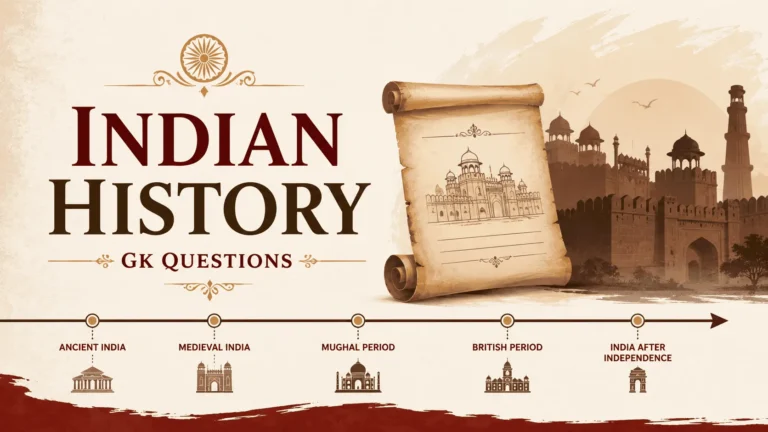
This first section of our 100 Easy General Knowledge Questions and Answers covers Indian History — freedom movement leaders, empires, and the reform movements that shaped modern India.
Q1. Who founded the Indian National Congress in 1885?
Ans. A.O. Hume
Fact: A retired British civil servant, Hume played a key role in bringing together India’s early political leaders under one platform. The first INC session was held in Bombay in December 1885, with Womesh Chandra Bonnerjee serving as its first president. This is one of the most frequently repeated facts across SSC’s History section, so it’s worth remembering both the founder and the first president together.
Q2. In which year was the Second Battle of Panipat fought?
Ans. 1556
Fact: It was fought between Akbar’s forces, led by his regent Bairam Khan, and Hemu, a general who had briefly captured Delhi. Akbar’s victory secured his hold on the Mughal throne at a time when it was seriously under threat. SSC often tests all three Battles of Panipat together, so it helps to remember them as a set rather than in isolation.
Q3. Who was the last Mughal Emperor of India?
Ans. Bahadur Shah II (Bahadur Shah Zafar)
Fact: He was exiled to Rangoon by the British after the Revolt of 1857, marking the formal end of Mughal rule in India. He was also a respected Urdu poet, and some of his verses are still widely quoted today. His exile is often cited as the symbolic end of nearly 300 years of Mughal presence in India.
Q4. Which movement did Mahatma Gandhi launch with the Dandi March in 1930?
Ans. Civil Disobedience Movement
Fact: The march itself was a protest against the British salt tax and monopoly on salt production. Gandhi walked around 390 km from Sabarmati Ashram to the coastal village of Dandi over 24 days. It’s considered one of the most significant acts of organized civil disobedience in the freedom struggle.
Q5. Who founded the Brahmo Samaj?
Ans. Raja Ram Mohan Roy
Fact: Founded in 1828, it was one of the earliest socio-religious reform movements in India, opposing practices like sati and child marriage. Roy is often referred to as the “Father of the Indian Renaissance” for his broader efforts toward social reform. His work laid the foundation for several later reform movements across the country.
Q6. In which year was the Indian National Congress founded?
Ans. 1885
Fact: Its first session was held in Bombay, with 72 delegates from across the country in attendance. The INC would go on to become the primary vehicle for India’s independence movement over the following decades. Remembering this date alongside the founder (A.O. Hume) helps with several related SSC questions.
Q7. Who became India’s first Governor-General under the Regulating Act of 1773?
Ans. Warren Hastings
Fact: The Act was Britain’s first attempt to regulate the East India Company’s affairs and centralize administration in India. Hastings held the position until 1785 and was later impeached in Britain over allegations of corruption, though he was eventually acquitted. His term set several early administrative precedents for British rule in India.
Q8. Which Act ended the East India Company’s trading activities, making it purely an administrative body?
Ans. Charter Act of 1833
Fact: This Act also made the Governor-General of Bengal the “Governor-General of India,” centralizing administrative control further. William Bentinck became the first person to hold this expanded title. It’s a commonly confused fact, since students often mix it up with the Charter Act of 1813, which only ended the Company’s trade monopoly, not all its trading activity.
Q9. Who founded the Arya Samaj in 1875?
Ans. Swami Dayanand Saraswati
Fact: The organization promoted a return to Vedic principles and opposed idol worship and caste discrimination. Its motto, “Krinvanto Vishwaram Aryam,” roughly translates to “make this world noble.” The Arya Samaj also played a significant role in promoting education, including women’s education, in northern India.
Q10. At which INC session was the resolution for “Purna Swaraj” (complete independence) first adopted?
Ans. Lahore Session, 1929
Fact: The session was presided over by Jawaharlal Nehru, and January 26 was declared “Independence Day” that year as a form of protest. This same date was later chosen, deliberately, for the Constitution’s implementation in 1950 — which is why India celebrates Republic Day on January 26 rather than any other date.
Important Battles in Indian History
| Battle | Year | Key Figures |
|---|---|---|
| First Battle of Panipat | 1526 | Babur vs Ibrahim Lodi |
| Second Battle of Panipat | 1556 | Akbar’s forces vs Hemu |
| Battle of Haldighati | 1576 | Maharana Pratap vs Akbar’s forces |
| Battle of Plassey | 1757 | Robert Clive vs Siraj-ud-Daulah |
| Battle of Buxar | 1764 | British East India Company vs Mir Qasim |
Geography GK Questions and Answers
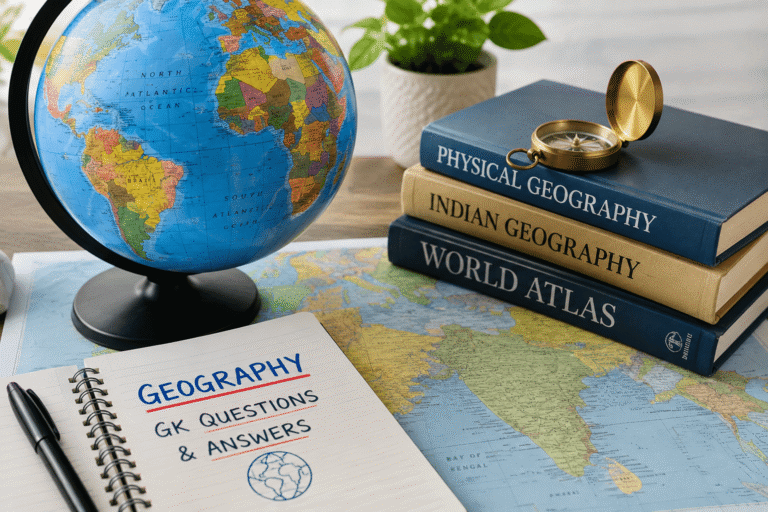
This second section of our 100 Easy General Knowledge Questions and Answers covers Indian Geography
Q11. Which river system forms the largest river basin in India?
Ans. Ganga Basin
Fact: It covers roughly a quarter of India’s total land area, spanning several northern and eastern states. The basin supports one of the highest population densities in the world due to its fertile alluvial soil. It’s also shared with Bangladesh, where the river eventually merges with the Brahmaputra before reaching the Bay of Bengal.
Q12. Which strait separates India and Sri Lanka?
Ans. Palk Strait
Fact: It lies between Tamil Nadu’s coast and northern Sri Lanka, connected to the Gulf of Mannar. The strait is relatively shallow, which historically limited large ship traffic through the region. It’s often confused with the Gulf of Mannar in exam questions, so it’s worth noting both names appear together frequently.
Q13. Which is the largest saltwater lagoon in India?
Ans. Chilika Lake
Fact: Located in Odisha, it’s also one of the largest wintering grounds for migratory birds in Asia. The lake’s salinity varies seasonally as it connects to the Bay of Bengal through a narrow channel. It was designated a Ramsar site (wetland of international importance) in 1981, one of the first in India to receive this status.
Q14. Which mountain pass connects India and China through Sikkim?
Ans. Nathu La
Fact: It’s one of the few open trading border posts between India and China, reopened for trade in 2006 after being closed since the 1962 war. It sits at an altitude of over 4,300 meters and was historically part of the ancient Silk Route. It remains strategically and economically significant for India-China trade relations.
Q15. Which is the world’s largest mangrove forest, partly located in India?
Ans. Sundarbans
Fact: Shared between India and Bangladesh, it’s also home to the Bengal tiger and is a UNESCO World Heritage Site. The Indian portion falls mainly in West Bengal, where it also serves as a natural barrier against coastal cyclones. Its dense mangrove roots make it one of the most ecologically unique regions in South Asia.
Q16. The Narmada River originates from which plateau?
Ans. Amarkantak Plateau
Fact: Located in Madhya Pradesh, this plateau is also the source of the Son River, which flows in the opposite direction. The Narmada is one of only a few major Indian rivers that flow from east to west into the Arabian Sea. This makes it a favorite exam question, since most major Indian rivers flow eastward instead.
Q17. Which Indian state is the largest producer of coffee?
Ans. Karnataka
Fact: The Chikmagalur and Kodagu regions of Karnataka account for the majority of India’s coffee production. Coffee cultivation in India began in these hilly regions centuries ago and remains concentrated there today. Kerala and Tamil Nadu are the other major coffee-producing states, though well behind Karnataka in volume.
Q18. Through how many Indian states does the Tropic of Cancer pass?
Ans. 8 states
Fact: These are Gujarat, Rajasthan, Madhya Pradesh, Chhattisgarh, Jharkhand, West Bengal, Tripura, and Mizoram. The Tropic of Cancer marks the northernmost point where the sun can appear directly overhead. This particular fact is a favorite in SSC exams, often asked alongside questions about the states it passes through in order.
Q19. Which river is known as the “Dakshin Ganga” (Ganga of the South)?
Ans. Godavari
Fact: It’s the second-longest river in India after the Ganga and flows through Maharashtra, Telangana, and Andhra Pradesh. It originates near Trimbakeshwar in Maharashtra and is considered sacred, much like the Ganga in the north. Its large delta region also supports extensive agriculture along the eastern coast.
Q20. Which is the largest freshwater lake in India?
Ans. Wular Lake
Fact: Located in Jammu & Kashmir, it’s formed by the Jhelum River and also acts as a natural flood-control basin. Its size varies significantly with the seasons, expanding considerably during the monsoon. It’s frequently confused with Dal Lake in exam questions, though Dal Lake is much smaller and more famous for tourism.
Indian Polity & Constitution GK Questions and Answers
This section of our 100 Easy General Knowledge Questions and Answers focuses on the Constitution, Articles, Amendments, and key constitutional roles — an area where precision genuinely matters in SSC exams.
Q21. Which Constitutional Amendment is known as the “Mini Constitution” of India?
Ans. 42nd Amendment (1976)
Fact: It made sweeping changes, including adding Fundamental Duties and the words “Socialist” and “Secular” to the Preamble. It was passed during the Emergency period and remains one of the most extensive single amendments in Indian constitutional history. Several of its provisions were later modified by the 44th Amendment in 1978.
Q22. Which Article of the Constitution guarantees the Right to Constitutional Remedies?
Ans. Article 32
Fact: Dr. B.R. Ambedkar called this article the “heart and soul” of the Constitution, as it allows citizens to directly approach the Supreme Court to enforce their fundamental rights. It empowers courts to issue writs like habeas corpus and mandamus. This makes it one of the most important and most frequently tested Articles in SSC’s Polity section.
Q23. Who was the first woman Speaker of the Lok Sabha?
Ans. Meira Kumar
Fact: She held the position from 2009 to 2014, during the 15th Lok Sabha. She was also the daughter of Jagjivan Ram, a prominent freedom fighter and former Deputy Prime Minister. Her election as Speaker was widely noted as a significant moment for women in Indian political leadership.
Q24. Which Schedule of the Constitution lists the officially recognized languages of India?
Ans. Eighth Schedule
Fact: It originally listed 14 languages and now includes 22, following successive amendments. Languages are added to this Schedule through constitutional amendments, most recently through the 92nd and 71st Amendments. It’s a commonly tested fact, especially the growth in the number of languages over time.
Q25. Which Part of the Constitution contains the Directive Principles of State Policy?
Ans. Part IV
Fact: These principles guide the government in policy-making but, unlike Fundamental Rights, are not enforceable by courts. They’re often described as being borrowed from the Irish Constitution’s concept of non-justiciable guidelines. Together with Fundamental Rights (Part III), they’re frequently compared and contrasted in SSC-level questions.
Q26. Who is the ex-officio Chairman of the Rajya Sabha?
Ans. The Vice President of India
Fact: This dual role means the Vice President presides over Rajya Sabha proceedings even though they aren’t an elected member of it. This is different from the Lok Sabha, which elects its own Speaker from among its members. It’s a frequently confused fact, since many assume the Speaker role applies equally to both houses.
Q27. Which Constitutional Amendment introduced the Goods and Services Tax (GST) in India?
Ans. 101st Amendment (2016)
Fact: It received presidential assent on September 8, 2016, though GST itself was rolled out on July 1, 2017. The amendment inserted new Articles, including 246A, to give both Parliament and state legislatures concurrent power to legislate on GST. It’s frequently confused with the 122nd Amendment Bill, which was its earlier form before being renumbered upon passage.
Q28. What is the minimum age required to become a member of the Lok Sabha?
Ans. 25 years
Fact: This is different from the Rajya Sabha, where the minimum age requirement is 30 years. These age limits are specified under Article 84 of the Constitution. This distinction between the two houses is a commonly tested comparison in SSC’s Polity questions.
Q29. Which Schedule of the Constitution contains the Anti-Defection Law?
Ans. Tenth Schedule
Fact: It was added through the 52nd Amendment in 1985 to curb political defections by elected members. It lays down the grounds on which a member can be disqualified for switching parties. This Schedule is regularly referenced in current affairs whenever defection-related political disputes make the news.
Q30. Who was independent India’s first Deputy Prime Minister?
Ans. Sardar Vallabhbhai Patel
Fact: He also served as India’s first Home Minister and is widely credited with the political integration of princely states. His efforts brought over 500 princely states into the Indian Union shortly after independence. He’s often referred to as the “Iron Man of India” for this achievement.
Science GK Questions and Answers
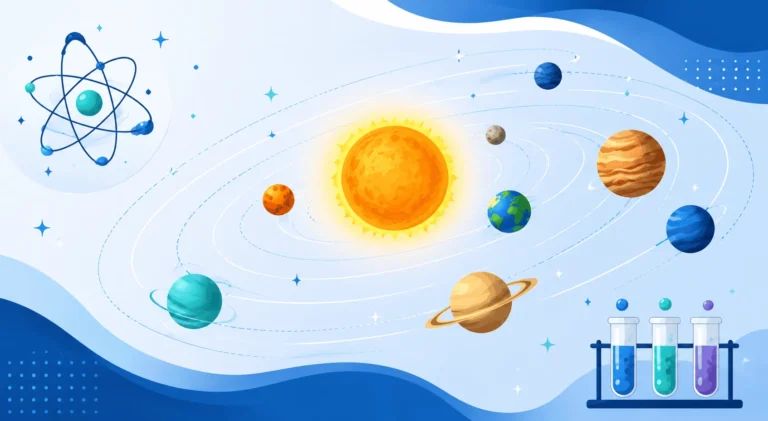
This fourth section of our 100 Easy General Knowledge Questions and Answers covers Science.
Q31. Which part of the human brain is responsible for balance and muscular coordination?
Ans. Cerebellum
Fact: It’s located at the back of the brain, below the cerebrum, and coordinates voluntary movements like posture and balance. Despite making up only about 10% of the brain’s total volume, it contains more than half of the brain’s total neurons. Damage to this region typically results in coordination and balance difficulties.
Q32. What is the pH value of pure water?
Ans. 7
Fact: A pH of 7 is considered neutral — below 7 is acidic, and above 7 is basic (alkaline). The pH scale itself ranges from 0 to 14, with 7 sitting exactly in the middle. This fact is often paired with questions about common acids and bases in SSC’s Science section.
Q33. Deficiency of which vitamin causes the disease Scurvy?
Ans. Vitamin C
Fact: Scurvy causes bleeding gums and fatigue, and was historically common among sailors on long voyages without fresh fruit. Citrus fruits like oranges and lemons are well known sources of Vitamin C. This is one of several vitamin-deficiency-disease pairs commonly tested together in GK sections.
Q34. What is the SI unit of electric current?
Ans. Ampere
Fact: It’s named after André-Marie Ampère, a French physicist considered one of the founders of electromagnetism. One ampere is defined based on the flow of electric charge per second through a conductor. It’s frequently tested alongside other SI units like the volt (for voltage) and the ohm (for resistance).
Q35. Which organ of the human body produces insulin?
Ans. Pancreas
Fact: Insulin is produced by beta cells within clusters called the Islets of Langerhans in the pancreas. Insulin plays a central role in regulating blood sugar levels in the body. Its malfunction is directly linked to diabetes, making this a commonly tested biology fact.
Q36. Who formulated the laws of planetary motion?
Ans. Johannes Kepler
Fact: His three laws describe how planets move in elliptical orbits around the Sun, laying groundwork for Newton’s later work on gravity. Kepler based his laws on the detailed astronomical observations of Tycho Brahe. His work marked a major shift away from the earlier belief that planetary orbits were perfect circles.
Q37. What is the normal pH range of human blood?
Ans. 7.35 to 7.45
Fact: This slightly alkaline range is tightly regulated by the body, since even small deviations can be medically serious. The body uses buffer systems, including bicarbonate, to maintain this narrow range. This is a more specific, “harder” version of the general pH question that’s also common in SSC papers.
Q38. Which metal remains liquid at room temperature?
Ans. Mercury
Fact: It’s used in thermometers and barometers due to its unique liquid state and consistent expansion with heat. Its chemical symbol, Hg, comes from the Latin word “hydrargyrum,” meaning liquid silver. Due to toxicity concerns, mercury thermometers have largely been replaced by digital alternatives in recent years.
Q39. What is the chemical formula of common salt?
Ans. NaCl
Fact: It stands for sodium chloride, formed from one sodium atom and one chlorine atom. It’s produced industrially through the evaporation of seawater or mined from underground salt deposits. This is one of the most basic chemical formulas tested in SSC’s Science section, often alongside water (H2O) and carbon dioxide (CO2).
Q40. Who discovered penicillin?
Ans. Alexander Fleming
Fact: He discovered it accidentally in 1928 when he noticed mould killing bacteria in a petri dish, leading to the first antibiotic. His discovery is widely regarded as one of the most important medical breakthroughs of the 20th century. He shared the 1945 Nobel Prize in Physiology or Medicine for this work.
Order of Planets from the Sun
| Position | Planet |
|---|---|
| 1 | Mercury |
| 2 | Venus |
| 3 | Earth |
| 4 | Mars |
| 5 | Jupiter |
| 6 | Saturn |
| 7 | Uranus |
| 8 | Neptune |
Sports GK Questions and Answers
This Fifth section of our 100 Easy General Knowledge Questions and Answers covers Sports
Q41. Which trophy is contested between India and Australia in Test cricket?
Ans. Border-Gavaskar Trophy
Fact: It’s named after former captains Allan Border (Australia) and Sunil Gavaskar (India). The trophy was introduced in 1996 to commemorate the rivalry and mutual respect between the two cricketing nations. It’s contested whenever India and Australia play a Test series, whether in India or Australia.
Q42. How many players are there on each side in a standard Kabaddi match?
Ans. 7
Fact: Each team fields 7 players on the mat at a time, with additional players held in reserve. Kabaddi is a contact sport of Indian origin, combining elements of wrestling and tag. It has grown significantly in popularity in recent years due to televised leagues like the Pro Kabaddi League.
Q43. What is India’s highest sporting honour, renamed in 2021 from the Rajiv Gandhi Khel Ratna Award?
Ans. Major Dhyan Chand Khel Ratna Award
Fact: The renaming honoured the legendary hockey player often called the “Wizard of Hockey.” It remains India’s highest sporting recognition, awarded annually for the most spectacular performance in a four-year period. This renaming is a genuinely recent change and a common current-affairs-meets-static-GK question in SSC papers.
Q44. Who is known as the “Wizard of Hockey” in India?
Ans. Major Dhyan Chand
Fact: He scored over 400 goals in his international career and won 3 Olympic gold medals with India. His birthday, August 29, is celebrated as National Sports Day in India. He’s often described as one of the greatest hockey players in the history of the sport.
Q45. Which city is set to host the 2028 Summer Olympics?
Ans. Los Angeles, USA
Fact: This will be the third time Los Angeles hosts the Summer Olympics, after 1932 and 1984. The 2032 Summer Olympics are separately scheduled to be held in Brisbane, Australia. Knowing upcoming host cities is a common current-affairs-adjacent GK question in SSC exams.
Q46. What is the standard length of a cricket pitch?
Ans. 22 yards
Fact: This is equal to one chain, an old English unit of measurement, and equals about 20.12 meters. The measurement has remained standardized across international cricket for well over a century. It’s often paired with other cricket-specific measurement questions, like the height of the stumps.
Q47. Which Grand Slam tennis tournament is played on clay courts?
Ans. French Open (Roland Garros)
Fact: The clay surface slows the ball down, generally favoring players with strong baseline rallies. It’s one of four Grand Slam tournaments, alongside the Australian Open, Wimbledon, and the US Open, each played on a different surface. Wimbledon, notably, is the only Grand Slam still played on grass.
Q48. Who was the first Indian woman to win an Olympic medal?
Ans. Karnam Malleswari
Fact: She won bronze in weightlifting at the 2000 Sydney Olympics. Her achievement came in the 69 kg category and remained a landmark moment for Indian women in Olympic sport. It would be another 12 years before another Indian woman, Saina Nehwal, won an individual Olympic medal.
Q49. In which year did India win its first Cricket World Cup?
Ans. 1983
Fact: India defeated the West Indies in the final at Lord’s, under the captaincy of Kapil Dev. The West Indies had been the dominant team in world cricket at the time, making India’s win a significant upset. This victory is widely credited with dramatically boosting cricket’s popularity across India.
Q50. Which sport is associated with the term “Slam Dunk”?
Ans. Basketball
Fact: It refers to a player forcefully scoring by putting the ball directly through the hoop from above the rim. It’s considered one of the most exciting and visually dramatic plays in the sport. The term is often used loosely outside sports too, to describe a certain or dominant outcome.
National Symbols GK Questions and Answers

This Sixth section of our 100 Easy General Knowledge Questions and Answers covers National Symbols
Q51. On which date was the Indian National Flag adopted?
Ans. July 22, 1947
Fact: It was adopted just weeks before India’s independence, by the Constituent Assembly. This gave the country an official flag in place before the transfer of power actually took place. The final design replaced an earlier version that included a spinning wheel instead of the Ashoka Chakra.
Q52. Who designed the Indian National Flag?
Ans. Pingali Venkayya
Fact: His original design was later modified to include the Ashoka Chakra in place of a spinning wheel. Venkayya had studied flags of various nations extensively before proposing his design to Indian leaders. He’s often referred to as the designer of the flag, even though the final adopted version differed slightly from his original.
Q53. India’s National Emblem is adapted from the Lion Capital of Ashoka, originally erected at which site?
Ans. Sarnath
Fact: The original sculpture dates back to around 250 BCE and now stands in the Sarnath Museum near Varanasi. It was originally erected by Emperor Ashoka to mark the site of Buddha’s first sermon. Only three of the original four lions are visible in the emblem, since the fourth sits directly behind the visible three.
Q54. What is the motto inscribed below the National Emblem of India?
Ans. Satyameva Jayate
Fact: It’s a Sanskrit phrase meaning “Truth Alone Triumphs,” taken from the ancient Mundaka Upanishad. It was formally adopted as India’s national motto on January 26, 1950, alongside the Constitution. It appears inscribed in Devanagari script directly beneath the emblem on official government seals.
Q55. What is the National Heritage Animal of India?
Ans. Elephant
Fact: It was declared in 2010 to boost conservation efforts, separate from the tiger, which is the National Animal. The declaration aimed to draw specific attention to threats facing India’s wild elephant population. This is a commonly confused pair of facts, since students often mix up the National Animal and National Heritage Animal.
Q56. What is the National Tree of India?
Ans. Banyan Tree
Fact: Known for its vast canopy and aerial roots, it’s considered a symbol of immortality in Indian tradition. A single banyan tree can spread across a very large area over centuries, supported by its aerial prop roots. It holds religious and cultural significance across several Indian traditions.
Q57. In which year was the Rupee symbol (₹) officially adopted?
Ans. 2010
Fact: It was designed by D. Udaya Kumar and is based on a combination of the Devanagari letter “र” and the Latin “R.” The symbol was selected through a public design competition held by the Government of India. Before this, the Indian Rupee had no distinct globally recognized currency symbol of its own.
Q58. Approximately how long does it take to sing the full version of the National Anthem?
Ans. 52 seconds
Fact: A shortened version, played on certain occasions, takes about 20 seconds. The full anthem consists of five stanzas, though only the first is typically sung on most occasions. This timing detail is a more specific, less commonly known fact compared to just knowing who wrote the anthem.
Q59. India has no officially declared “National Language” — which language instead holds the status of Official Language of the Union?
Ans. Hindi
Fact: This is a common misconception in general knowledge — the Constitution designates Hindi (in Devanagari script) as the official language, not a “national” one. English continues to be used as an associate official language for governmental and legislative purposes. This distinction is frequently tested precisely because so many people assume otherwise.
Q60. How many spokes are there in the Ashoka Chakra on the Indian National Flag?
Ans. 24
Fact: The wheel represents the eternal wheel of law (Dharma Chakra) and is navy blue in colour. It’s positioned at the center of the flag, on the white band, replacing the earlier spinning wheel design. Each spoke is sometimes symbolically associated with a specific virtue, though this interpretation varies across sources.
Important Days GK Questions and Answers
This Seventh section of our 100 Easy General Knowledge Questions and Answers covers important Days.
Q61. Which day is observed as National Science Day in India, commemorating the discovery of the Raman Effect?
Ans. February 28
Fact: It marks the day in 1928 when Sir C.V. Raman announced his discovery, for which he later won the Nobel Prize in Physics. The Raman Effect relates to how light scatters when it passes through a transparent material. This day is often used to promote science communication and public interest in scientific research across India.
Q62. Which day is observed as World Population Day?
Ans. July 11
Fact: It was established by the UN in 1989 to draw attention to global population issues. The date was chosen close to the day in 1987 when world population reached approximately five billion. It’s observed to raise awareness about population growth, family planning, and related development issues.
Q63. Which day is observed as National Unity Day, marking Sardar Patel’s birth anniversary?
Ans. October 31
Fact: It was introduced in 2014 and is also known as “Rashtriya Ekta Diwas.” The date marks the birth anniversary of Sardar Vallabhbhai Patel, who’s remembered for unifying India’s princely states after independence. The Statue of Unity, the world’s tallest statue, was also built in his honour.
Q64. Which day is observed as Hindi Diwas in India?
Ans. September 14
Fact: It marks the day in 1949 when the Constituent Assembly adopted Hindi as the official language of the Union. It’s observed with various events promoting the use of Hindi in official and everyday communication. This is distinct from World Hindi Day, which is observed separately on January 10.
Q65. Which day is observed as World Wildlife Day?
Ans. March 3
Fact: The date marks the anniversary of the signing of CITES (Convention on International Trade in Endangered Species) in 1973. It’s observed globally to raise awareness about the conservation of wild flora and fauna. Each year’s observance typically has a specific conservation-related theme.
Q66. Which day is observed as National Voters’ Day in India?
Ans. January 25
Fact: It marks the foundation day of the Election Commission of India, established in 1950. It’s observed to encourage greater voter participation and awareness, especially among newly eligible young voters. New voters are often formally enrolled and felicitated as part of the day’s events.
Q67. Which day is observed as World Ozone Day?
Ans. September 16
Fact: It marks the anniversary of the 1987 Montreal Protocol, an international treaty to protect the ozone layer. The Protocol is widely regarded as one of the most successful international environmental agreements to date. It’s observed to raise awareness about ozone layer depletion and the substances that cause it.
Q68. Which day is observed as Human Rights Day?
Ans. December 10
Fact: It marks the day in 1948 when the UN General Assembly adopted the Universal Declaration of Human Rights. The declaration set out, for the first time, fundamental human rights to be universally protected across all nations. It’s observed globally with events focused on human rights awareness and advocacy.
Books, Authors & Awards GK Questions and Answers
This eighth section of our 100 Easy General Knowledge Questions and Answers covers books, Authors and awards
Q69. Who wrote the novel “Godan”?
Ans. Munshi Premchand
Fact: Published in 1936, it’s considered one of the finest works of Hindi literature, focusing on rural poverty and exploitation. The title translates to “The Gift of a Cow,” referring to the protagonist’s central struggle throughout the novel. Premchand is widely regarded as one of the most influential Hindi and Urdu writers of the 20th century.
Q70. Which is India’s highest award in the field of literature?
Ans. Jnanpith Award
Fact: Instituted in 1961, it’s given only to Indian writers for works in languages listed in the Eighth Schedule, plus English since 2013. It includes a citation, a cash prize, and a bronze replica of the goddess Saraswati. It’s considered more prestigious than the Sahitya Akademi Award, which is also literary but less exclusive.
Q71. Who was the first recipient of the Jnanpith Award in 1965?
Ans. G. Sankara Kurup
Fact: He received it for his Malayalam poetry collection “Odakkuzhal” (The Bamboo Flute), published in 1950. He was also honoured with the Padma Bhushan and the Sahitya Akademi Award earlier in his career. His win marked the very first recognition under this now-prestigious literary honour.
Q72. Which award recognizes excellence in sports coaching in India?
Ans. Dronacharya Award
Fact: It’s named after Dronacharya, the legendary teacher of archery and warfare in the Mahabharata. It’s given to coaches who have produced medal-winning performances at major international competitions. It’s distinct from the Khel Ratna and Arjuna Awards, which recognize athletes rather than coaches.
Q73. Who wrote “Malgudi Days”?
Ans. R.K. Narayan
Fact: The stories are set in the fictional South Indian town of Malgudi, a recurring setting across many of his works. The collection was also adapted into a popular Indian television series in the late 1980s. Narayan is considered one of the pioneers of Indian writing in English.
Q74. Into how many categories are the Padma Awards divided?
Ans. Three
Fact: These are the Padma Vibhushan, Padma Bhushan, and Padma Shri, in decreasing order of distinction. They’re announced annually on the eve of Republic Day and awarded in fields like arts, public affairs, science, and sports. Unlike the Bharat Ratna, the Padma Awards are given across a much wider range of fields and recipients each year.
Q75. Who wrote “Rajmohan’s Wife,” considered India’s first English-language novel?
Ans. Bankim Chandra Chatterjee
Fact: Though better known for his Bengali works, this 1864 novel was his only one written directly in English. He’s more widely remembered for writing “Vande Mataram,” India’s National Song. His later works, mostly in Bengali, had a far greater influence on Indian literature than this early English novel.
Q76. Who was the first woman to win the Jnanpith Award?
Ans. Ashapoorna Devi
Fact: She won it in 1976 for her Bengali novel “Pratham Pratishruti” (The First Promise). The novel was the first in a trilogy exploring the lives and struggles of women across generations. Several other women writers, including Amrita Pritam and Mahasweta Devi, have gone on to win the award in the years since.
Full Forms & Abbreviations GK Questions and Answers
This ninth section of our 100 Easy General Knowledge Questions and Answers covers Full forms and abbreviations.
Q77. What is the full form of NABARD?
Ans. National Bank for Agriculture and Rural Development
Fact: It was established in 1982 to provide credit and development support for rural India. It functions as an apex institution overseeing agricultural and rural credit through cooperative banks and regional rural banks. It plays a central role in India’s rural financial infrastructure.
Q78. What is the full form of IRDAI?
Ans. Insurance Regulatory and Development Authority of India
Fact: It regulates and promotes the insurance industry in India, similar to how SEBI regulates the stock market. It was established following the recommendations of the Malhotra Committee in the 1990s. It’s headquartered in Hyderabad, unlike most other major financial regulators, which are based in Mumbai or Delhi.
Q79. What is the full form of SEBI?
Ans. Securities and Exchange Board of India
Fact: It was given statutory powers in 1992 to regulate India’s securities and capital markets. Its primary role is to protect investor interests and ensure fair, transparent trading practices. It also regulates stock exchanges, brokers, and listed companies operating in India.
Q80. What is the full form of FEMA?
Ans. Foreign Exchange Management Act
Fact: Enacted in 1999, it replaced the earlier FERA (Foreign Exchange Regulation Act) to ease foreign exchange rules. The shift from FERA to FEMA reflected India’s broader move toward economic liberalization. It governs how foreign exchange transactions are conducted within India.
Q81. What is the full form of NHAI?
Ans. National Highways Authority of India
Fact: It’s responsible for developing, maintaining, and managing India’s national highway network. It was established in 1988 and operates under the Ministry of Road Transport and Highways. Major infrastructure projects, including large expressway networks, fall under its jurisdiction.
Q82. What is the full form of UIDAI?
Ans. Unique Identification Authority of India
Fact: It’s the government body responsible for issuing the 12-digit Aadhaar number. It was established in 2009 and has since issued Aadhaar numbers to well over a billion residents of India. Aadhaar has since become a key identity document used across various government and private services.
Q83. What is the full form of FSSAI?
Ans. Food Safety and Standards Authority of India
Fact: It regulates and supervises food safety standards in the country and issues the license required for food businesses. It was established under the Food Safety and Standards Act, 2006. Its logo, along with a license number, is a familiar sight on most packaged food products sold in India.
Q84. What is the full form of CAG (in the Indian constitutional context)?
Ans. Comptroller and Auditor General of India
Fact: This constitutional authority audits all receipts and expenditures of the Union and State governments. The office is established under Article 148 of the Constitution and submits its reports directly to the President or Governor concerned. Its reports are often central to major public accountability debates in Parliament.
World General Knowledge Questions and Answers in English
This tenth section of our 100 Easy General Knowledge Questions and Answers covers world GK
Q85. Which is the smallest continent in the world by area?
Ans. Australia
Fact: Despite being the smallest continent, it’s the sixth-largest country in the world by total area. It’s the only continent that’s also entirely occupied by a single country. This makes for a commonly tested contrast, since Australia is simultaneously the smallest continent and a fairly large country.
Q86. Which strait separates Asia from North America?
Ans. Bering Strait
Fact: It separates Russia’s Chukotka Peninsula from Alaska and connects the Pacific and Arctic Oceans. At its narrowest point, the two continents are separated by just around 82 km of water. During ice ages, this area was periodically a land bridge, believed to be how early humans first migrated into the Americas.
Q87. What is the official currency of Saudi Arabia?
Ans. Saudi Riyal
Fact: It has been pegged to the US dollar at a fixed exchange rate since 1986. This peg helps stabilize the currency given Saudi Arabia’s heavy reliance on oil exports priced in dollars. Currency questions like this are commonly tested for major Gulf and G20 economies in SSC’s World GK section.
Q88. In which African country is Mount Kilimanjaro located?
Ans. Tanzania
Fact: It’s the highest mountain in Africa and one of the famous “Seven Summits,” the tallest peak on each continent. Unlike many tall mountains, it can technically be climbed without specialized mountaineering equipment. It’s a free-standing mountain, not part of any mountain range, which makes it fairly unique geographically.
Q89. Which is the world’s largest coral reef system?
Ans. Great Barrier Reef
Fact: Located off the coast of Queensland, Australia, it’s visible even from outer space. It stretches over 2,300 km and is made up of thousands of individual reefs and hundreds of islands. It’s also a UNESCO World Heritage Site and one of the most biodiverse marine ecosystems on Earth.
Q90. Which country is known as the “Land of the Thunder Dragon”?
Ans. Bhutan
Fact: The name comes from “Druk Yul,” referring to thunder dragons believed to inhabit its mountains in local mythology. Bhutan is also known for measuring progress through “Gross National Happiness” rather than relying solely on GDP. It remains one of the few carbon-negative countries in the world.
Q91. Which is the world’s largest freshwater lake by volume?
Ans. Lake Baikal
Fact: Located in Russia, it holds roughly 20% of the world’s unfrozen freshwater reserves. It’s also the world’s deepest lake, reaching depths of over 1,600 meters. Despite its size, it’s often confused with the larger-by-surface-area Great Lakes of North America, which hold less total volume of water combined.
Q92. In which city is the World Trade Organization (WTO) headquartered?
Ans. Geneva, Switzerland
Fact: The WTO oversees global trade rules and resolves trade disputes between member nations. It was established in 1995, succeeding the earlier General Agreement on Tariffs and Trade (GATT). Geneva also hosts several other major international organizations, including WHO and several UN bodies.
Current Personalities of India GK Questions and Answers
This eleventh section of our 100 Easy General Knowledge Questions and Answers covers current personality.
Q93. Who serves as the ex-officio Chairman of NITI Aayog?
Ans. The Prime Minister of India (currently Narendra Modi)
Fact: Unlike its predecessor, the Planning Commission, NITI Aayog functions as a policy think tank rather than a fund-allocating body. It was established in 2015 to promote cooperative federalism between the Centre and states. Its Vice Chairman handles much of the day-to-day functioning, since the Chairman role is largely ceremonial in practice.
Q94. Who is the current Chairperson of the Securities and Exchange Board of India (SEBI)?
Ans. Tuhin Kanta Pandey
Fact: He is the 11th Chairperson of SEBI, India’s capital markets regulator. SEBI Chairpersons are typically appointed for a term of three years, extendable by the government. This role is frequently featured in current-affairs-based GK questions given how often regulatory leadership changes are in the news.
Q95. Who is the current Chairman of the Indian Space Research Organisation (ISRO)?
Ans. Dr. V. Narayanan
Fact: ISRO’s Chairman also serves as Secretary of the Department of Space, Government of India. This dual role links India’s space program directly to the national government’s policy structure. ISRO leadership changes are closely tracked in GK questions given the agency’s high public profile.
Q96. Who is the current Attorney General for India?
Ans. R. Venkataramani
Fact: The Attorney General is the Indian government’s chief legal advisor and its primary lawyer before the Supreme Court. The position is appointed under Article 76 of the Constitution and serves at the pleasure of the President. It’s distinct from the Solicitor General, who assists the Attorney General in legal matters.
Q97. Who is the current Chief of Defence Staff of India?
Ans. General N.S. Raja Subramani
Fact: The Chief of Defence Staff is the single-point military advisor to the Government of India, a post created in 2019. It was established following long-standing recommendations for better coordination between the Army, Navy, and Air Force. General Bipin Rawat was the first officer to hold this position.
Q98. Who is the current Chief Election Commissioner of India?
Ans. Gyanesh Kumar
Fact: The Chief Election Commissioner heads the Election Commission of India, the body responsible for conducting free and fair elections. The Commission is a constitutional authority established under Article 324. This role is central to nearly every election-related current affairs question in SSC exams.
Q99. Who is the current Solicitor General of India?
Ans. Tushar Mehta
Fact: The Solicitor General assists the Attorney General and represents the government in significant court matters. Unlike the Attorney General, this position isn’t a constitutional post but is created by the government as needed. Both roles are frequently confused in exam questions, so it’s worth remembering the distinction.
Q100. Who is the current Governor of the Reserve Bank of India?
Ans. Sanjay Malhotra
Fact: He is the 26th Governor of the RBI, India’s central bank, and took charge in December 2024. The RBI Governor’s role includes setting monetary policy and overseeing the country’s banking system. This is one of the most frequently updated “current personality” questions in SSC’s General Awareness section, given how closely economic policy is tracked.
That brings this 100 Easy General Knowledge Questions and Answers and General knowledge questions with answers for ssc collection to a close — from freedom movement facts to today’s key officeholders, this list is meant to be a genuine one-stop revision resource rather than just another trivia list.
You should also check:
- Best Study Plan for SSC Preparation 2026
- Best Books for SSC Preparation 2026
- Check Weekly current affairs (20- 26 july, 2026)
Important Links
| Resource | Link |
|---|---|
| Join WhatsApp Channel | Click Here |
| Join Telegram Channel | Click Here |
Writes General Knowledge and informative content for RozgarOfficial. Works in the Central Government, has cleared SSC multiple times, and has appeared for State PCS Mains — bringing real exam-preparation experience to his writing.