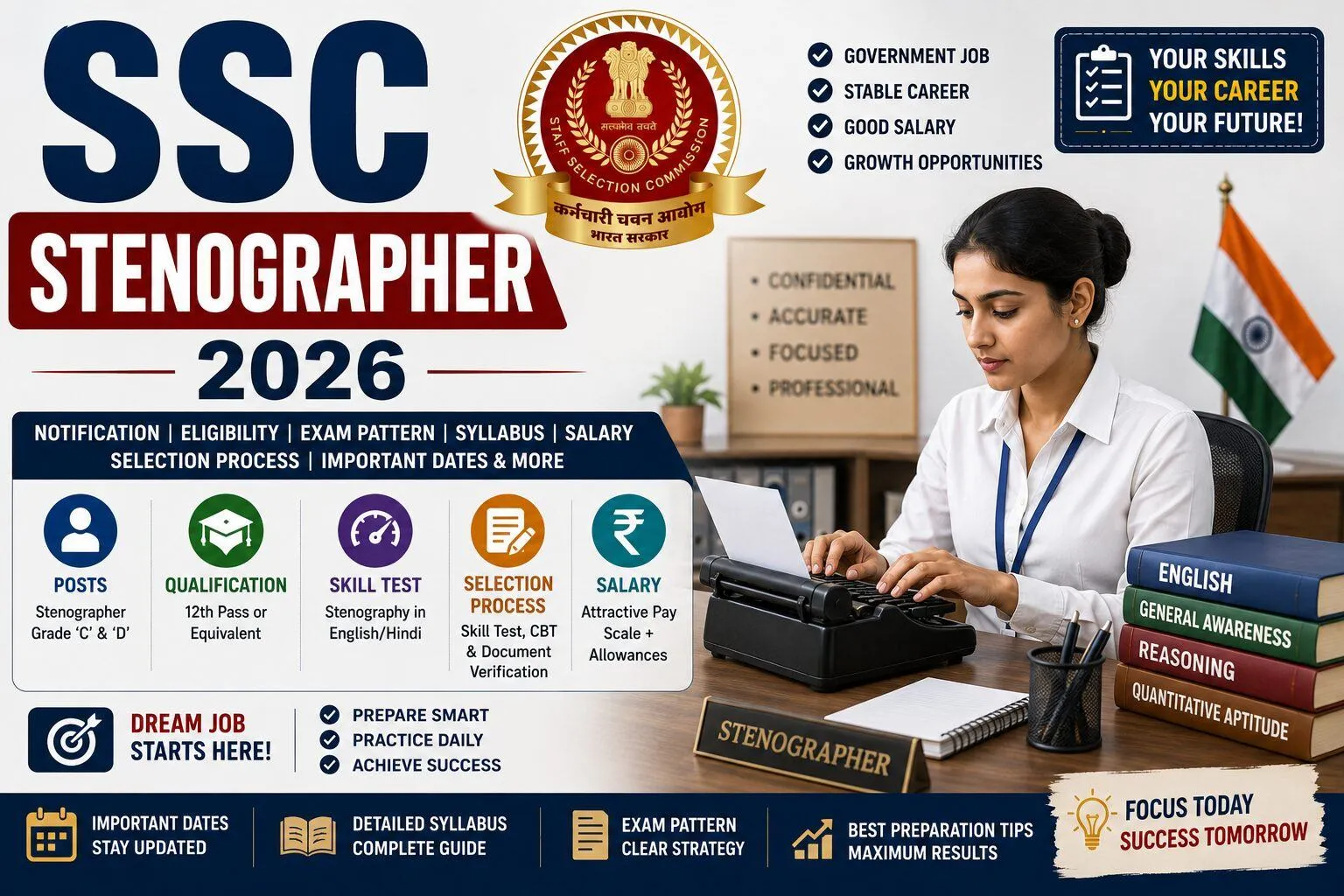
SSC Stenographer Grade C and D Complete Guide 2026 (Eligibility, Syllabus, Salary, Skill Test, Cut Off & Career)
This SSC Stenographer Grade C and D Complete Guide is meant to be the only page you need. If you’ve landed here, you’re probably trying to piece together information scattered across a dozen different sites — one for eligibility, another for syllabus, a third for cut off, and none of them agreeing on the salary figure.
It covers eligibility, exam pattern and timing, syllabus, the skill test, the full selection process, how to actually fill the application form, job profile, Grade C vs Grade D differences, posting cities, preference selection, salary, promotions, departmental exams, vacancy and important dates, previous year cut off, and a realistic preparation strategy — in that order, so you can either read it start to finish or jump straight to the section you need.
The Staff Selection Commission conducts this exam every year to recruit Stenographer Grade C and Grade D staff for ministries, departments, and organisations of the Government of India. What makes it different from most other SSC exams is that there’s no Mathematics section, but there is a second-stage shorthand and typing skill test that decides whether you actually get selected.
SSC Stenographer Eligibility Criteria
Before applying, make sure you actually meet the eligibility requirements — SSC rejects a surprising number of applications every year over avoidable eligibility mistakes.
Educational Qualification
Candidates must have passed Class 12 (10+2) or an equivalent examination from a recognized board or university. Qualifications obtained through open or distance learning are accepted only if the institution is approved by the UGC-DEB. There’s no graduation requirement for either grade — this is genuinely an exam built for 12th-pass candidates.
Age Limit
| Post | Minimum Age | Maximum Age |
|---|---|---|
| Stenographer Grade C | 18 years | 30 years |
| Stenographer Grade D | 18 years | 27 years |
Age is calculated as on the cut-off date specified in that year’s official notification. Standard SSC age relaxation rules apply for reserved categories:
- SC/ST candidates: 5 years relaxation
- OBC candidates: 3 years relaxation
- PwBD candidates: 10–15 years relaxation depending on category
- Ex-servicemen and certain other categories: relaxation as per government norms
Nationality
Candidates must be citizens of India, or subjects of Nepal/Bhutan, or Tibetan refugees who settled in India before January 1, 1962, with the intention of permanent residence.
Number of Attempts
There is no fixed limit on the number of attempts for SSC Stenographer. You can apply every year for as long as you fall within the prescribed age limit for that year’s notification — this is one of the more beginner-friendly aspects of this exam compared to services with a capped attempt count.
This is SSC Stenographer Grade C and D Complete Guide which will provide every detail you need to know about this exam.
SSC Stenographer Exam Pattern and Timing
The selection process happens in stages, starting with a Computer-Based Test (CBT), followed by a Skill Test in Stenography for those who clear it.
CBT Exam Pattern
| Section | Number of Questions | Marks |
|---|---|---|
| General Intelligence & Reasoning | 50 | 50 |
| General Awareness | 50 | 50 |
| English Language & Comprehension | 100 | 100 |
| Total | 200 | 200 |
Key points about the CBT:
- Total duration: 2 hours
- Question type: Objective, multiple-choice
- Available in both English and Hindi
- Negative marking: 0.25 marks deducted for every wrong answer
- There is no sectional cut-off — your total score across all three sections is what matters
- Notably, there’s no Mathematics/Quantitative Aptitude section, which is one of the biggest reasons aspirants who are weak in Maths choose this exam
Exam Timing and Shifts
The CBT is conducted across multiple days and typically in three shifts per day — commonly a morning slot (around 9:00 AM–11:00 AM), an early-afternoon slot (around 12:30 PM–2:30 PM), and an evening slot (around 4:00 PM–6:00 PM), though exact timings vary by cycle and are confirmed only on your individual admit card.
A few things to keep in mind around exam-day timing:
- SSC releases a City Intimation Slip a few days before the admit card, telling you your exam city so you can plan travel
- The admit card itself, with your exact shift, reporting time, and gate closing time, is usually released about 4 days before the exam
- Reporting time is generally 45–60 minutes before your shift starts, and it’s genuinely worth arriving even earlier to account for security checks and biometric verification
- Gate closing time is strict — typically 15–30 minutes before the shift begins — and candidates arriving after this are not permitted entry under any circumstances
- Shift allocation is done by SSC and cannot be changed once assigned, regardless of personal preference
Always treat your own admit card as the final word on timing — general timing patterns like the ones above can shift slightly between cycles.
Read More about 100 Easy General Knowledge Questions and Answers in English
SSC Stenographer Syllabus
The CBT syllabus covers three subjects. Here’s the subject-wise breakdown.
General Intelligence & Reasoning
- Analogies and similarities/differences
- Coding-decoding
- Classification (verbal and non-verbal)
- Series (number and figure)
- Blood relations
- Arithmetical reasoning
- Space visualization
- Problem solving, analysis, judgement, and decision making
- Discriminating observation and visual memory
- Non-verbal series and relationship concepts
General Awareness
- Current affairs (national and international)
- History
- Geography
- Indian Polity and the Constitution
- Economics
- General Science
- Static GK (awards, books and authors, important days, etc.)
English Language & Comprehension
- Grammar (tenses, articles, prepositions, voice, narration)
- Vocabulary and synonyms/antonyms
- Spot the error / error detection
- Sentence improvement and rearrangement
- Fill in the blanks
- Reading comprehension
- One-word substitution
- Idioms and phrases
Since English carries the single highest weightage in the CBT (100 out of 200 marks), it deserves proportionally more of your daily preparation time than the other two subjects combined.
SSC Stenographer Skill Test: Speed, Dictation & Transcription Time
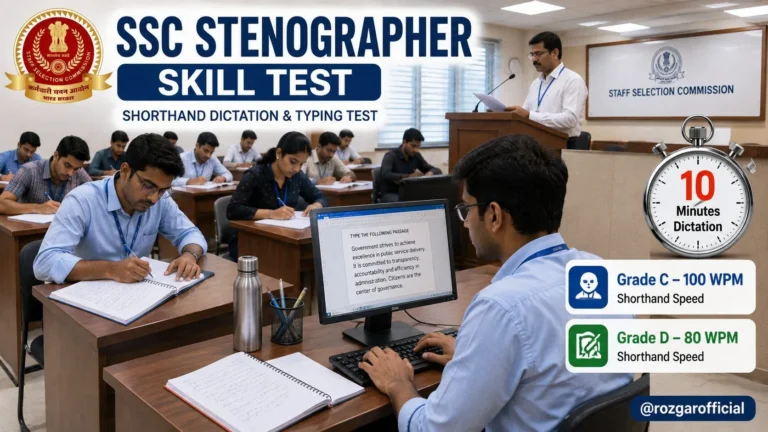
This is the stage that genuinely separates SSC Stenographer from almost every other SSC exam.
Dictation Speed Requirement
| Post | Dictation Speed | Dictation Duration |
|---|---|---|
| Stenographer Grade C | 100 words per minute (w.p.m.) | 10 minutes |
| Stenographer Grade D | 80 words per minute (w.p.m.) | 10 minutes |
A passage is read aloud (in English or Hindi, based on what you selected in your application form) for exactly 10 minutes, and you must take it down in shorthand at the required speed.
Transcription Time
| Post | English Transcription Time | Hindi Transcription Time |
|---|---|---|
| Stenographer Grade C | 40 minutes | 55 minutes |
| Stenographer Grade D | 50 minutes | 65 minutes |
Important things to know about the Skill Test:
- It is qualifying in nature — it doesn’t add to your merit score, but you must clear it to be selected
- There’s a permissible error margin, and evaluation is strict — spelling mistakes, omitted words, and wrong words all count against you during transcription
- The medium (English or Hindi) you select in your application form determines both your transcription time and your dictation stream
- Reading back your own shorthand outlines accurately is often the harder skill, not writing them fast — many candidates who write fast still lose marks because they can’t read their own notes back correctly
If you don’t already know shorthand, this is the part of your preparation that needs to start early — shorthand speed genuinely takes months to build, not weeks.
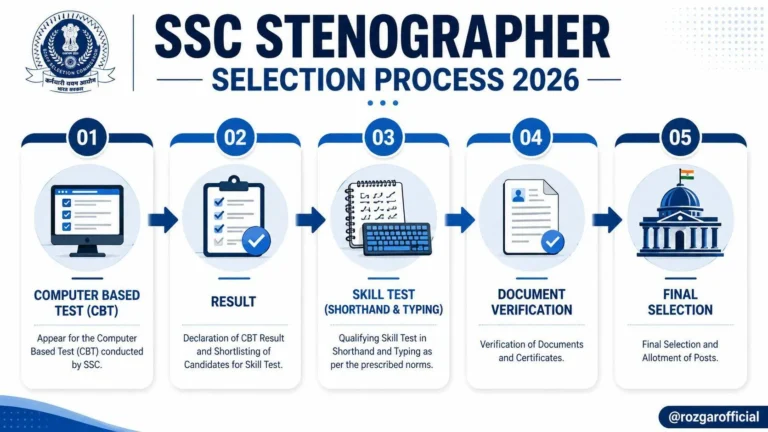
SSC Stenographer Selection Process
Selection happens in stages, and you need to clear each one to move to the next.
- Computer-Based Test (CBT) — the written exam covering Reasoning, General Awareness, and English, worth 200 marks
- Skill Test in Stenography — the shorthand dictation and transcription test, qualifying in nature
- Document Verification — verification of your educational certificates, age proof, category certificates (if applicable), and other documents
- Medical Examination — for certain posts with specific physical/medical standards (this applies to select departments, not all Stenographer posts)
Final selection and merit ranking is based on your CBT score, provided you’ve also cleared the qualifying Skill Test, document verification, and any post-specific medical standards.
How to Fill the SSC Stenographer Application Form
Applying is entirely online through SSC’s official portal, and the process is split into two parts.
Step 1: One-Time Registration (OTR)
If you haven’t registered on ssc.gov.in before, you’ll need to complete One-Time Registration first. This involves entering your Aadhaar number, name, date of birth, gender, and basic educational details, after which you’ll receive a Registration ID and set a password.
Step 2: Fill the Application Form
Once registered (or logged in, if you already have an OTR account):
- Log in using your Registration ID, password, and date of birth
- Click on the SSC Stenographer Grade ‘C’ & ‘D’ Examination link under active notifications
- Fill in personal details, communication address, and educational qualification details
- Select your preferred examination centre, medium (English/Hindi for the skill test), and post preference (Grade C, Grade D, or both, if eligible)
- Upload your photograph and signature as per specifications (see below); some recent cycles have also introduced a live photo capture feature via webcam instead of uploading an old photo
- Preview your form carefully — check every field against your actual documents before submitting
- Pay the application fee online (debit/credit card, net banking, or UPI)
- Submit the form and download/print a copy for your own records
Document and Photo Specifications
| Document | Format | Size |
|---|---|---|
| Passport-size photograph | JPEG | 20 KB – 50 KB |
| Signature | JPEG | 10 KB – 20 KB |
Keep scanned copies of your Class 10 and Class 12 certificates, a valid photo ID, and a disability certificate (if applicable) ready before you start, since the form asks for these details directly.
Application Fee
| Category | Fee |
|---|---|
| General / OBC / EWS | ₹100 |
| SC / ST / Women / PwBD / Ex-Servicemen | Exempted |
A few things worth knowing before you submit:
- Applications are accepted only online — there’s no offline submission except in specific exceptional circumstances SSC may notify separately
- Once submitted, no changes are entertained outside the official correction window, so double-check every field before hitting submit
- SSC typically opens a short correction window a few days after the application deadline — use it if you spot a genuine error
- Blurred or non-compliant photographs and signatures are a common reason for rejected applications, so stick to the exact size and format specifications
SSC Stenographer Job Profile
Once selected, an SSC Stenographer is posted in a ministry, department, or attached/subordinate office of the Government of India. The day-to-day work centers around supporting senior officers with documentation and communication.
Typical responsibilities include:
- Taking shorthand dictation from senior officers and transcribing it into official documents
- Typing letters, reports, notes, and circulars
- Managing official correspondence and scheduling
- Assisting officers during meetings and press briefings, and helping prepare press statements
- Filing and maintaining official records and documentation
- General administrative support — managing appointments, handling routine office tasks
Grade C vs Grade D: Job Profile Difference
| Aspect | Grade C | Grade D |
|---|---|---|
| Classification | Group B, Non-Gazetted | Group C, Non-Gazetted |
| Typical Officer Level Supported | Senior officers, often confidential and high-priority work | General administrative and clerical stenography duties |
| Nature of Work | More responsibility, often direct assistance to senior officials | Routine documentation and clerical stenography support |
| Career Growth | Comparatively faster promotions | Slightly slower, but still steady |
SSC Stenographer Postings and Posting Cities
Postings work differently for the two grades, and it’s worth understanding this before you decide which one to prioritize.
- Grade C posts are largely concentrated in Delhi and Delhi-based central ministries and departments — think Ministry of Finance, CBIC, CBDT, Ministry of External Affairs, and similar high-level offices. Historically, SSC notifications have stated Grade C postings as mostly Delhi-based, though candidates should always check the current year’s notification, since posting policies can be revised.
- Grade D posts are split into two groups:
- Group X: Delhi and nearby regions, similar to Grade C
- Group Y: Offices, departments, and subordinate/attached offices spread across various States and Union Territories of India
In practice, this means Grade D offers a wider geographical spread of postings — including a real chance of a posting closer to your home state — while Grade C postings are more concentrated in Delhi. There’s no guarantee of a “home state” posting for either grade; final allocation depends on your merit rank, category, vacancy availability, and the requirements of the recruiting department at the time. Some posts, such as certain Grade D vacancies in the Border Roads Organisation (BRO), also carry specific eligibility conditions like being open only to male candidates and higher medical standards — always check post-specific notes in the official notification rather than assuming all postings follow the same rules.
Preference Selection: The Option-Cum-Preference Form
This is a step many first-time aspirants don’t know about until they’re already deep into the process, so it’s worth understanding well in advance.
After you clear the Skill Test but before the final result is declared, SSC opens an Option-cum-Preference Form on its portal. This is where you list, in order, which posts and departments you’d prefer to be allocated to.
How it works:
- You log in to your SSC account, go to the “My Application” or dashboard section, and find the Option-cum-Preference link
- You select and rank your preferred posts/departments in order — typically from a long list covering dozens of ministries, departments, and organisations
- Final post allocation is done strictly on merit-cum-preference — meaning candidates with better CBT scores get first pick from the departments still available, based on the order they ranked their own preferences
- Submitting this form is mandatory. If you don’t submit your preferences within the given window, you will not be considered for the final selection list, regardless of your score
- Once submitted, your last saved version is treated as final — you can revise your preferences multiple times within the window, but not after it closes
- PwBD candidates must be especially careful to select only posts identified as suitable for their specific disability category; selecting an unsuitable post can lead to cancellation of candidature later by the user department
On choosing preferences: popular first choices among aspirants often include departments like the Ministry of External Affairs (which can lead to overseas postings after a few years of service) and Ministry of Defence, largely because of long-term career and posting benefits — but the “best” department genuinely depends on your own priorities around location, work environment, and growth path, not a single universal ranking.
Some recent cycles have also introduced a “sliding mechanism” as part of the final allocation process, where candidates may need to select a venue, date, and slot to confirm their allocation in person — missing this step in person typically means being treated as absent for final selection. Always check the specific notice for your exam cycle for the latest process, since this has evolved across recent years.
This is SSC Stenographer Grade C and D Complete Guide which will provide every detail you need to know about this exam.
SSC Stenographer Salary and Pay Scale
| Detail | Grade C | Grade D |
|---|---|---|
| Pay Level | Level 6 and Level 7 | Level 4 |
| Pay Scale | ₹35,400 – ₹1,12,400 and ₹44,900 to ₹1,42,400 | ₹25,500 – ₹81,100 |
| Approx. Gross Salary | ₹50,000–₹65,000 and ₹85,000 to ₹91,000 (varies by city) | ₹37,000–₹52,000 (varies by city) |
| Approx. In-Hand Salary | ₹45,000–₹55,000 and ₹75,000 to ₹82,000 (varies by city) | ₹35,000–₹45,000 (varies by city) |
| Governing Pay Commission | 7th Pay Commission | 7th Pay Commission |
- On top of basic pay, SSC Stenographers receive Dearness Allowance (DA), House Rent Allowance (HRA), and Transport Allowance (TA), along with standard central government benefits like paid leave, medical facilities, and pension/NPS contributions. Actual in-hand salary varies depending on your city of posting — metro postings generally come with higher HRA.
Note: Exact figures can shift slightly with each DA revision and pay commission update, so always cross-check the latest number against your appointment letter or the official notification rather than treating these as fixed forever.
Promotions and Career Growth
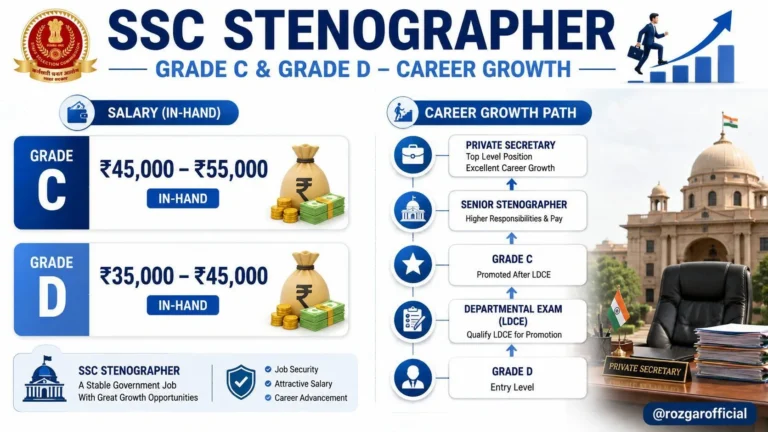
SSC Stenographer offers a genuinely structured promotion path, though the pace differs somewhat between the two grades.
- Grade C stenographers, due to their higher starting responsibilities, generally see comparatively faster promotions
- Grade D stenographers have a slightly slower promotion path, mostly progressing through subordinate offices, but the path is just as real
Typical career progression includes:
- Stenographer Grade D → Stenographer Grade C (via departmental exam, covered below)
- Stenographer Grade C → Senior Stenographer / Private Secretary, with further progression toward supervisory or gazetted-level roles over time
Promotions depend on a combination of seniority, years of service, work efficiency and performance reviews, and clearing the relevant departmental exam. Many departments also provide time-bound promotions tied to years of service, in addition to the merit-based departmental exam route. Ongoing training in stenography, office procedures, and office software also plays a role in how quickly a stenographer is considered ready for the next level.
Departmental Exams: Grade D to Grade C Promotion
One of the clearest upward paths for a Stenographer Grade D employee is through SSC’s Limited Departmental Competitive Examination (LDCE) for Stenographer Grade C.
Key points about this departmental exam:
- It is conducted by SSC specifically for eligible, regularly appointed Stenographer Grade D employees already working in various central government services and cadres — it is not open to the general public or fresh candidates
- Eligibility typically requires a minimum number of years of regular service as a Grade D stenographer (commonly around 3 years, though exact eligibility years are specified in each cycle’s official notification and can vary slightly by cadre)
- Interested and eligible candidates must apply online and ensure supporting documents reach SSC by the notified deadline through the proper departmental channel
- Selection through this route depends on both clearing the departmental exam and the candidate’s overall work efficiency and service record
- This exam is conducted periodically (not necessarily every single year), based on the number of Grade C vacancies available departmentally
In short: if you join as a Grade D stenographer, this departmental exam — combined with steady performance and seniority — is your structured route into Grade C, rather than needing to apply afresh through the general SSC Stenographer exam.
SSC Stenographer Vacancy and Important Dates
Vacancy numbers fluctuate meaningfully year to year based on departmental requirements. Recent cycles have seen figures ranging from under 300 to over 1,500 combined vacancies across Grade C and Grade D, so always check the specific year’s notification rather than relying on a previous cycle’s numbers.
| Event | Typical Timeline |
|---|---|
| Notification Release | Usually April |
| Application Window | Late April to Late May (approx. 20 days) |
| Application Correction Window | A few days after the application deadline |
| CBT (Tier 1) | Typically July–September |
| Skill Test | A few months after the CBT result |
| Option-cum-Preference Form | After Skill Test, before final result |
| Final Result | Following document verification and any post-specific checks |
Candidates should also note that SSC does not release state-wise or zone-wise vacancy breakdowns in advance for this exam — vacancy numbers are given at the overall Grade C/Grade D level, with department-wise allocation only becoming clear during the preference and allocation stage.
Always cross-check exact dates, vacancy numbers, and any procedural changes against the current official notification on ssc.gov.in before planning around them, since SSC’s exam calendar and processes can shift between cycles.
SSC Stenographer Previous Year Cut Off
Cut off marks give you a realistic target to prepare toward, but they shift year to year based on vacancies, number of applicants, and difficulty level of that year’s paper.
CBT Cut Off (Written Stage) — Recent Cycle
| Category | Approx. Cut Off |
|---|---|
| UR | ~148.5 |
| SC | ~138 |
| ST | ~115 |
| OH | ~109 |
| VH | ~78 |
Final Cut Off (After Skill Test) — 2024 Exam Cycle
| Category | Grade C | Grade D |
|---|---|---|
| UR | 166.99 | 156.94 |
| OBC | 166.22 | 154.07 |
| EWS | 165.97 | 154.12 |
| SC | 160.81 | 150.17 |
| ST | 140.65 | 129.73 |
For reference, the minimum qualifying percentage at the CBT stage is generally around 30% for UR, 25% for OBC/EWS, and 20% for SC/ST/PwBD/ESM categories — but the actual cut off is almost always well above this minimum, since it depends on competition that year.
A quick note on using cut off data: treat these numbers as a general benchmark, not a guarantee. Vacancy count, number of applicants, and paper difficulty all shift the cut off up or down each year, so aim comfortably above the previous year’s figure rather than exactly at it.
This is SSC Stenographer Grade C and D Complete Guide which will provide every detail you need to know about this exam.
SSC Stenographer Grade C and Grade D Complete Guide: Full Comparison
| Point of Difference | Grade C | Grade D |
|---|---|---|
| Age Limit | 18–30 years | 18–27 years |
| Dictation Speed | 100 w.p.m. | 80 w.p.m. |
| English Transcription Time | 40 minutes | 50 minutes |
| Pay Level | Level 6 (₹35,400–₹1,12,400) | Level 4 (₹25,500–₹81,100) |
| Approx. In-Hand Salary | ₹45,000–₹55,000 | ₹35,000–₹45,000 |
| Classification | Group B, Non-Gazetted | Group C, Non-Gazetted |
| Typical Posting | Mostly Delhi-based ministries | Group X (Delhi) or Group Y (across India) |
| Career Growth | Comparatively faster | Slightly slower, but steady |
| Difficulty to Clear | Higher (faster speed, shorter transcription window) | Comparatively more manageable for beginners |
If you’re just starting out with shorthand and unsure which grade to target, Grade D’s slightly lower speed requirement and longer transcription window can make it a more realistic first attempt, with Grade C as a target once your shorthand speed genuinely improves — and remember, the departmental exam route above means Grade D isn’t a dead end even if Grade C feels out of reach right now.
SSC Stenographer Preparation Strategy
Preparing for SSC Stenographer really has two separate tracks that need to run in parallel: your CBT preparation (Reasoning, GA, English) and your shorthand/typing preparation for the Skill Test. Treating the Skill Test as an afterthought is one of the most common reasons candidates clear the CBT but still don’t get selected.
CBT Preparation
- English: Since this carries 100 of the 200 marks, prioritize grammar fundamentals, daily vocabulary, and error detection practice. Reading editorials and short passages daily builds comprehension speed over time.
- Reasoning: A single good practice book covering verbal and non-verbal reasoning, revised regularly, is usually enough — this section rewards repetition more than variety of resources.
- General Awareness: Split your time between static GK (history, polity, geography, science) and the last 6–12 months of current affairs, since SSC tends to draw questions from both.
- PYQs: Solve as many previous year papers as you can get — SSC repeats question patterns often enough that this alone meaningfully improves your score.
Skill Test (Shorthand) Preparation
- Start learning shorthand early if you don’t already know it — this genuinely takes months of consistent daily practice, not a last-minute crash course
- Practice dictation at gradually increasing speeds, working up to your target w.p.m. (100 for Grade C, 80 for Grade D) well before your test date
- Spend real time practicing reading back your own shorthand outlines — this is where many candidates lose marks even after writing fast enough
- Practice transcribing on a computer keyboard specifically, since typing speed and accuracy under time pressure matters as much as shorthand speed itself
- Take timed mock dictations regularly in the final months, simulating the exact 10-minute dictation plus transcription window you’ll face on test day
That covers the strategy side of things — combined with the eligibility, syllabus, salary, and process details above, this SSC Stenographer Grade C and D Complete Guide should leave you with everything you need before you sit for the exam.
Also check How to Start SSC Preparation from Zero
Frequently Asked Questions (FAQs)
Q1. What is the qualification required for SSC Stenographer? Candidates must have passed Class 12 (10+2) or an equivalent examination from a recognized board. There’s no graduation requirement.
Q2. What is the age limit for SSC Stenographer Grade C and Grade D? Grade C requires candidates to be between 18–30 years, while Grade D requires 18–27 years, with standard age relaxation for reserved categories.
Q3. How many attempts are allowed for SSC Stenographer? There is no fixed attempt limit. Candidates can apply every year as long as they meet the age criteria for that year’s notification.
Q4. Is there Mathematics in the SSC Stenographer exam? No. The SSC Stenographer CBT covers only General Intelligence & Reasoning, General Awareness, and English Language & Comprehension — there is no Maths section.
Q5. What is the required dictation speed for SSC Stenographer? Grade C requires 100 words per minute, and Grade D requires 80 words per minute, both dictated for exactly 10 minutes.
Q6. Is the SSC Stenographer Skill Test qualifying or does it add to the merit score? The Skill Test is qualifying in nature. You must clear it to be selected, but your final merit ranking is based on your CBT marks.
Q7. What is the transcription time in the SSC Stenographer Skill Test? Grade C candidates get 40 minutes (English) or 55 minutes (Hindi), while Grade D candidates get 50 minutes (English) or 65 minutes (Hindi).
Q8. What is the job profile of an SSC Stenographer? The role primarily involves taking shorthand dictation, transcribing official documents, managing correspondence, assisting senior officers, and general administrative support.
Q9. Where are SSC Stenographers usually posted? Grade C postings are largely concentrated in Delhi-based central ministries. Grade D postings are split into Group X (Delhi) and Group Y (spread across states and union territories).
Q10. What is the Option-cum-Preference Form in SSC Stenographer recruitment? It’s a mandatory form submitted after the Skill Test but before the final result, where candidates rank their preferred posts and departments. Final allocation is based on merit-cum-preference.
Q11. What is the salary of an SSC Stenographer? Grade C stenographers earn an approximate in-hand salary of ₹45,000–₹55,000 per month, while Grade D stenographers earn approximately ₹35,000–₹45,000 per month, depending on city of posting.
Q12. Can a Stenographer Grade D get promoted to Grade C? Yes, primarily through the Limited Departmental Competitive Examination (LDCE) for Grade D employees with the required years of regular service, combined with seniority and performance record.
Q13. Is there negative marking in the SSC Stenographer CBT? Yes, 0.25 marks are deducted for every incorrect answer in the Computer-Based Test.
Q14. How do I apply for the SSC Stenographer exam? You need to complete One-Time Registration (OTR) on ssc.gov.in, then log in and fill the application form, upload your photograph and signature as per specifications, pay the fee (if applicable), and submit before the deadline.
Q15. What is a safe score to aim for in the SSC Stenographer CBT? Based on recent trends, aiming for a score comfortably above 150–160 out of 200 gives you a reasonably safe margin for Grade C, though this varies by category and year.
Q16. Can a complete beginner learn shorthand for SSC Stenographer? Yes, but it takes sustained daily practice over several months. Starting shorthand practice early, well before the Skill Test stage, is essential for beginners.
Q17. What documents are needed to fill the SSC Stenographer application form? You’ll need Aadhaar details, Class 10 and Class 12 certificates, a valid photo ID, and scanned photograph and signature in the specified JPEG size ranges.
Q18. Do SSC Stenographers get promoted automatically over time? Not automatically — promotions depend on a mix of seniority, years of service, performance record, and (for Grade D to Grade C) clearing the relevant departmental exam.
You should also check:
- Best Study Plan for SSC Preparation
- How to Start SSC Preparation from Zero
- Check Weekly current affairs (20- 26 july, 2026)
Important Links
| Resource | Link |
|---|---|
| Official SSC Website | Click Here |
| Official Notification PDF | Click Here |
| Join WhatsApp Channel | Click Here |
| Join Telegram Channel | Click Here |
********
Disclaimer: This article is intended to provide a comprehensive overview of the SSC Stenographer Grade C and D Complete Guide including eligibility, syllabus, exam pattern, salary, selection process, and other important details. While we make every effort to keep the information accurate and up to date, the Staff Selection Commission (SSC) may revise its notification, eligibility criteria, exam pattern, vacancies, dates, or other guidelines at any time. Therefore, candidates are strongly advised to verify the latest information by referring to the official SSC notification and website before submitting an application or making any important decisions. This guide is for informational purposes only and should not be considered a substitute for the official notification.

Writes General Knowledge and informative content for RozgarOfficial. Works in the Central Government, has cleared SSC multiple times, and has appeared for State PCS Mains — bringing real exam-preparation experience to his writing.